
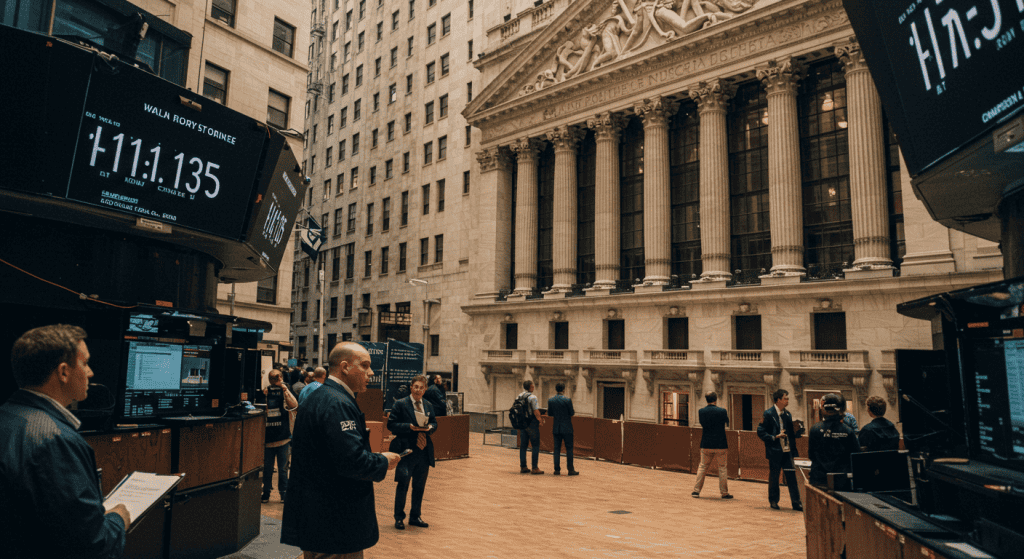
Beneath the towering skyscrapers of Manhattan, a vibrant energy pulses through a historic district, home to a titan of global finance. This institution, synonymous with economic power and market movements, stands as a central pillar in the world’s financial architecture. It is where fortunes are made and lost, where the value of corporations is determined, and where the pulse of global capitalism can often be felt most keenly. Its iconic facade attracts tourists, while its daily operations dictate the economic narratives of nations.
The Epicenter of Capital Markets
The New York Stock Exchange, often referred to simply as the NYSE, is more than just a building on Wall Street; it is a fundamental pillar of the global economic system. At its core, what is the New York Stock Exchange? It is the largest stock exchange in the world by market capitalization of its listed companies, serving as a marketplace where buyers and sellers trade shares of publicly traded corporations. This venerable institution facilitates capital formation for businesses and provides investment opportunities for individuals and institutions across the globe. Its operations are critical for the smooth functioning of international finance, making it a focal point for economic news and analysis. Indeed, what is the New York Stock Exchange famous for extends beyond its sheer size; it is a symbol of American economic might and a primary indicator of market sentiment and corporate valuation.
A Deep-Rooted History and Iconic Home
The story of the NYSE began under a buttonwood tree in 1792, where 24 stockbrokers and merchants signed the Buttonwood Agreement, establishing rules for securities trading. This early pact laid the groundwork for what would become the world’s most influential stock exchange. A concise history of NYSE summary for students would highlight its evolution from a modest gathering to a sophisticated, technologically advanced trading platform. Over centuries, it has weathered financial panics, economic booms, and technological revolutions, consistently adapting to remain at the forefront of financial markets. The distinctive building, located at 11 Wall Street, is immediately recognizable, making the location of New York Stock Exchange building a landmark destination. Its grand architecture, with columns and flags, has become an enduring image of global commerce.
Understanding NYSE Operations and Trading
The NYSE operates primarily as an auction market, a distinguished feature compared to other exchanges. This means that buyers and sellers, or their representatives, compete for the best price on the trading floor. Historically, the NYSE was known for its bustling trading floor, where brokers would vocally make bids and offers. While technology now dominates much of the trading volume, the concept of a designated market maker (DMM) remains central. DMMs are responsible for maintaining a fair and orderly market in specific stocks. For those interested in market timings, understanding NYSE trading hours is essential. Generally, the exchange operates from 9:30 a.m. to 4:00 p.m. Eastern Time on weekdays. However, these hours can be impacted by various factors, including holidays. Investors should check for details on New York Stock Exchange hours to plan their trading activities. Furthermore, anticipating when the market will be closed is also key, as trading is suspended during New York Stock Exchange holidays. The fundamental concept of a stock exchange definition is to provide a platform for trading securities, ensuring transparency and liquidity.
Ownership, Influence, and the Global Stage
A common question pertains to the entity behind this financial giant: who owns the New York Stock Exchange? Since 2013, the NYSE has been owned by Intercontinental Exchange (ICE), an American Fortune 500 company that operates global exchanges and clearing houses. ICE acquired NYSE Euronext, broadening its portfolio of financial market infrastructure. This ownership structure places the NYSE within a larger conglomerate that spans various asset classes and geographic regions. The NYSE’s influence extends far beyond its physical location, impacting global economies through the performance of its listed companies, which include many of the world’s largest and most innovative corporations. Its sheer market capitalization and the volume of transactions processed daily underscore its ongoing significance as a primary venue for capital allocation and wealth generation, maintaining its status as a critical barometer of economic health.
